📚 Book Progress Update
From Concepts to
Formal Semantics
Ontology Engineering Series · Chapters 1-17.9 Complete
YSYasen Star
••17 ChaptersOntologyKnowledge GraphSemantic Web
✓
Stage 1
Conceptual Modeling
✓
Stage 2
Semantic Description
⏳
Stage 3
Knowledge Reuse
🔜
Stages 4-7
Coming Soon
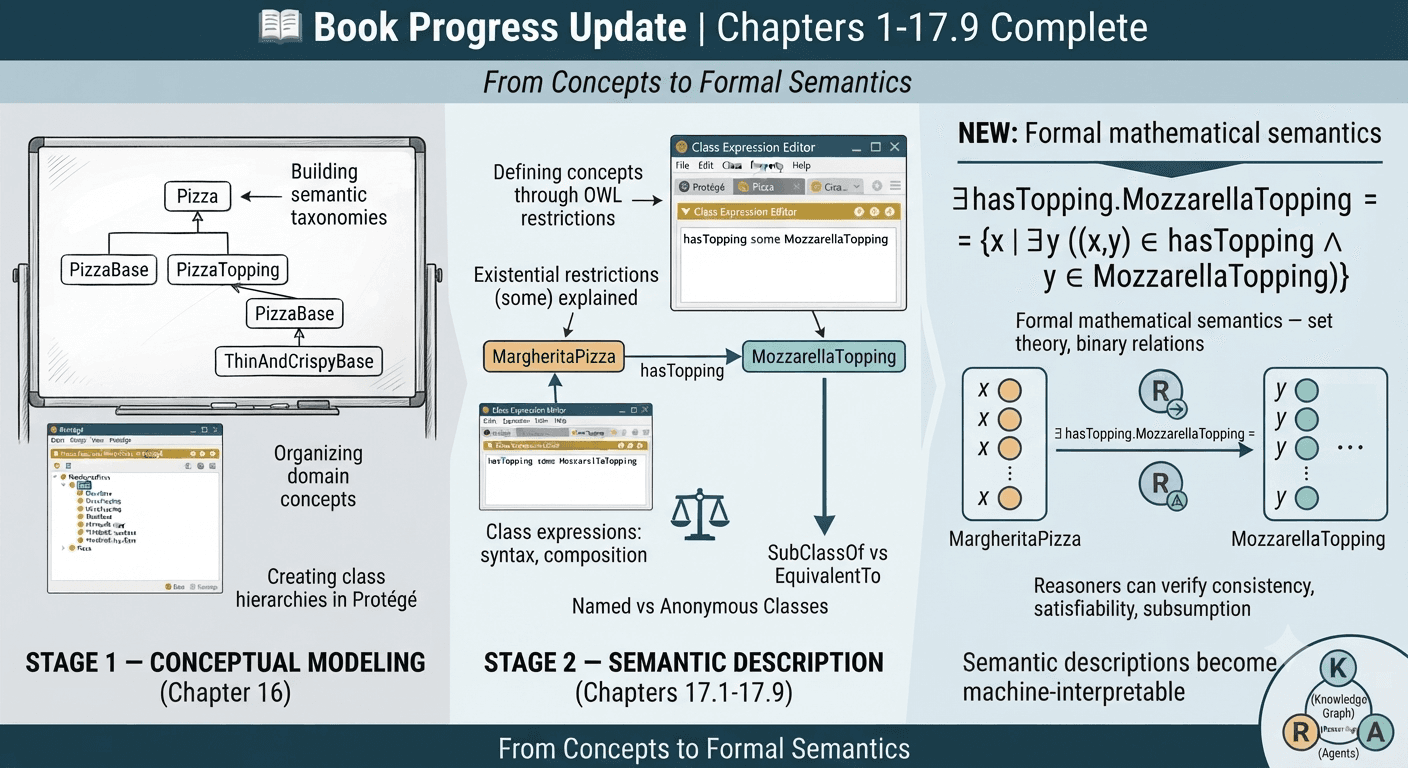
🧮 Ontology Engineering Series: Chapters 1-17.9 — Formal Semantics Deep Dive
📌 Latest Update: Semantic Interpretation of Class Expressions
We're systematically building a complete ontology engineering methodology. The Semantic Knowledge Development Lifecycle (SKDL) is a 7-stage framework for constructing machine-interpretable knowledge systems.
Current Milestone: Stage 2 — Semantic Description (complete through Chapter 17.9)
Core Contribution: Mathematical Semantics of OWL
We formalize the interpretation of class expressions using:
- Set Theory — Classes as subsets of a domain
- Binary Relations — Object properties as
R ⊆ ΔI × ΔI - Existential Quantification —
∃ R.C = {x | ∃ y ((x,y) ∈ R ∧ y ∈ C)} - Set Operations — Conjunction = intersection, Disjunction = union, Negation = complement
- Interpretation Functions —
I = (ΔI, ·I)maps syntax to formal meaning
Why This Matters for Engineers
| Property | Engineering Value |
|---|---|
| Consistency checking | Detect logical contradictions automatically |
| Satisfiability | Identify over-constrained concepts |
| Subsumption | Automate classification without manual hierarchy maintenance |
| Decidability | Guaranteed termination of reasoning |
| Open World Assumption | Support incremental knowledge growth |
Key Engineering Distinction
◀ Necessary
SubClassOfSemantic enrichment — adds conditions
▶ Necessary + Sufficient
EquivalentToComplete logical definition
💡 Guideline:
Use SubClassOf during early development. Upgrade to EquivalentTo only when concepts are stable.
Practical vs Theoretical Balance
| Focus Area | Content |
|---|---|
| 🛠️ Protégé Practice | Exercise 15: adding existential restrictions via Class Expression Editor |
| 📝 Syntax | Manchester OWL grammar, class expression composition |
| 🧠 Semantics | Set-theoretic interpretation, model theory |
| ⚙️ Engineering | Incremental development, validation, reasoning workflows |
What's Next
- 🏛️ Historical perspective (Aristotle → Description Logic)
- 🏗️ EKA architecture — how
K(Knowledge Graph) prepares forR(Reasoning) - ♻️ Stage 3 — Knowledge Reuse
📖 Explore the full content:
GitHub Repository